The Project
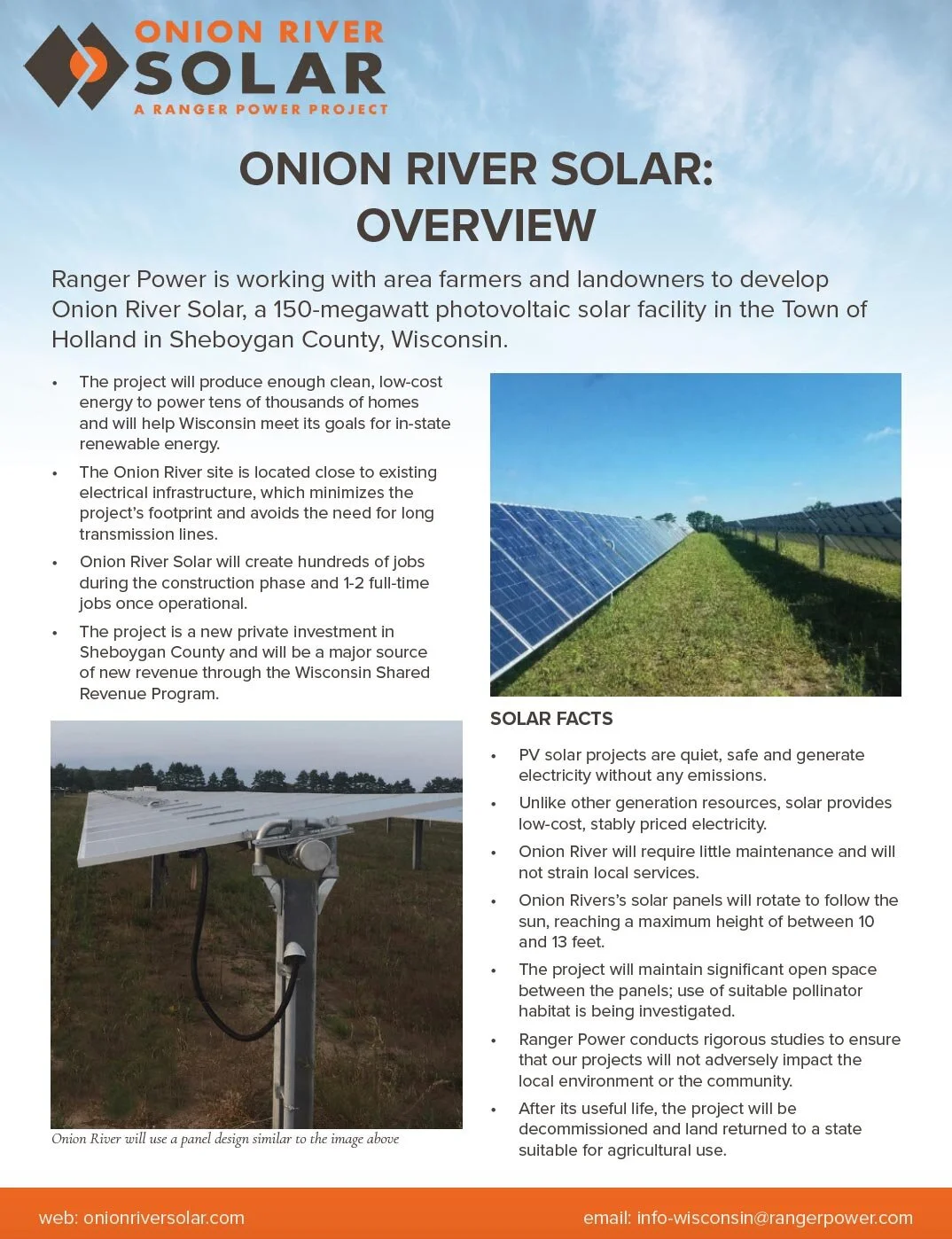
Download the Project Overview Fact Sheet
New map added below to show preferred and alternate siting
Onion River Solar is a proposed 150-megawatt (MW) solar photovoltaic generation facility to be located in the Town of Holland in Sheboygan County, Wisconsin. The project will provide clean, locally generated electric power to an electric utility or cooperative while providing significant environmental and economic benefits in the local community.
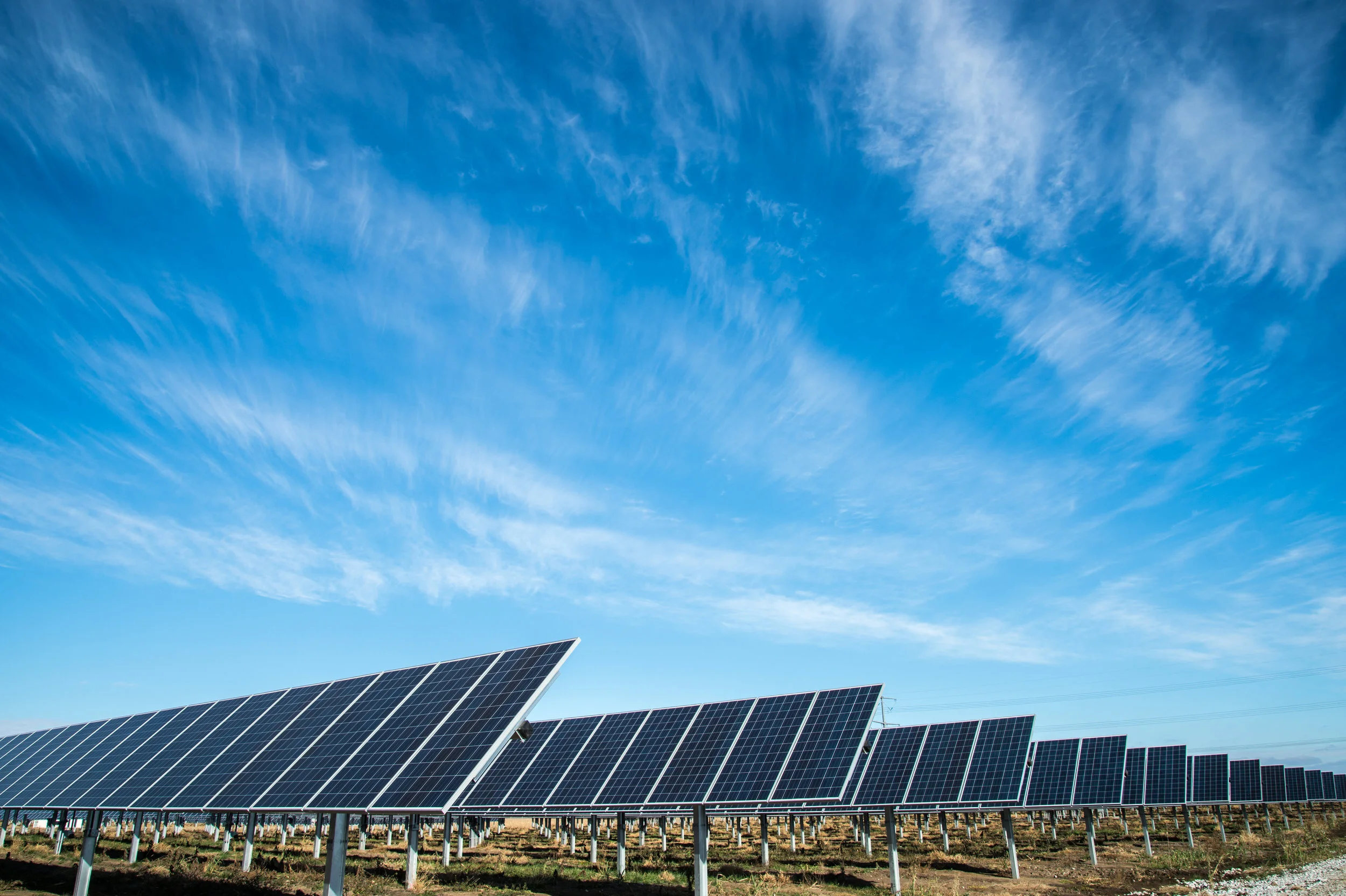
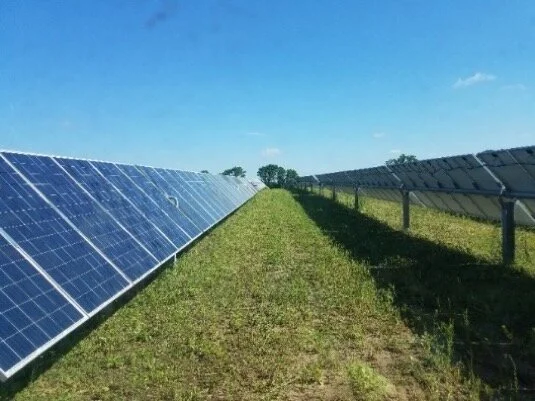
Rows of photovoltaic panels, surrounded by prairie grasses and pollinators compatible with grazing and beekeeping, would be located on the open and sunny portions of the land of private landowners who have chosen to participate in the project. Rows would be separated by 16-20 feet.
Panels are advanced models of those that have been used for years on houses and commercial buildings and would be arranged on racks that rotate to track the sun. The facility will be designed to prevent glare and to minimize noise. Panels would be kept a minimum of 150 feet or more from neighboring houses. The electricity generated would be transmitted to a Wisconsin-based electric utility using an existing electric transmission substation on Risseeuw Road.
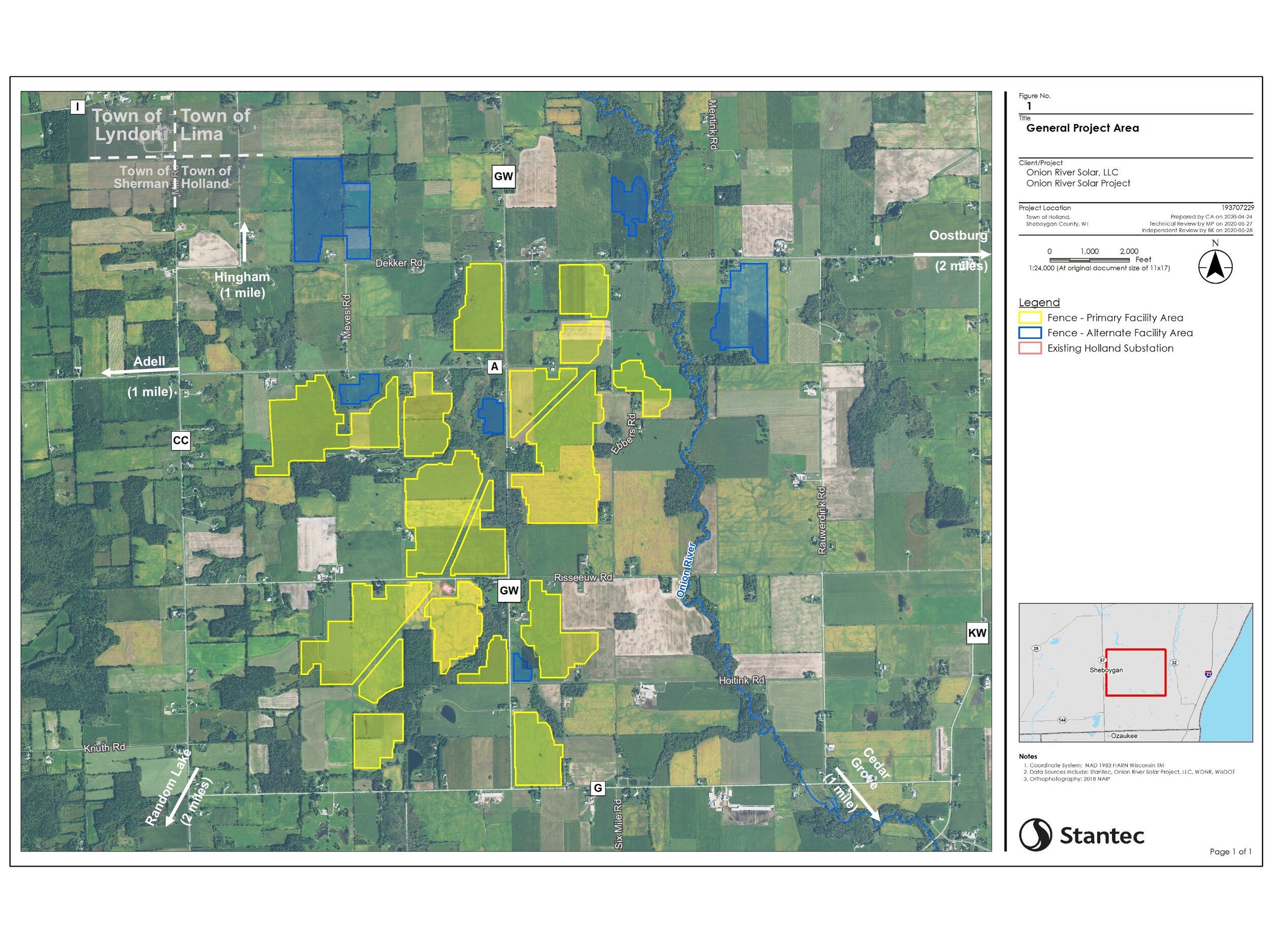
Above is a map showing the preferred siting (or “Primary Area”) for Onion River Solar with areas shaded in yellow. Areas shaded in blue are available as alternate siting (“Alternate Area”) for some of the project, in accordance with the state permitting requirement for adequate land to site 25% more generation area than will ultimately be needed, so that the proposal can be readily adjusted if necessary.
Proposed facility locations avoid environmental features such as natural forested areas and the 100-year floodplain, and reflect setbacks from roads and houses. Locations of fences are indicated by the solid outlines of the shaded areas and show open areas between generating areas, along natural features and along the existing electric transmission line.
The Primary Area includes 876 acres inside the fence. When panels are in their horizontal position (covering the most area), the panels cover approximately 255 of the 876 acres. The Alternate Area includes 197 acres inside the fence, of which 56 acres would be covered by panels when horizontal. Option contracts on all offered land that is not used will be released and will not affect land use
The growth of farm-based solar generation in Wisconsin is not likely to have a meaningful impact on the total amount of agricultural land available in the county or in the state. The project represents less than 1% of the active farmland in Sheboygan County. In fact, Wisconsin could produce approximately 50% of the electric energy consumed annually in the state through the use of solar panels on well under 2% of its total harvested cropland.*
(*See the U.S. Energy Information Administration and U.S. Department of Agriculture websites for the Wisconsin state 2017 total electric energy use here and the total harvested cropland here.)
Onion River Solar is designed to be light on the land, with posts that support the racks of panels driven directly into the ground without separate foundations. Stands of trees would remain and significant grading is minimized. During operation, the prairie and pollinator environment will deliver benefits similar to the Conservation Reserve Program. When it reaches the end of its useful life, which is estimated to be 30-35 years, the equipment will be removed and the land restored such that the owner can again use it for agriculture, if desired.
Buried wires connecting the rows of panels will lead first to inverters that convert direct current to alternating current and then from inverters to a step-up transformer, where the voltage will be increased to transmission system levels for connection to a new transmission substation to be located on project land.
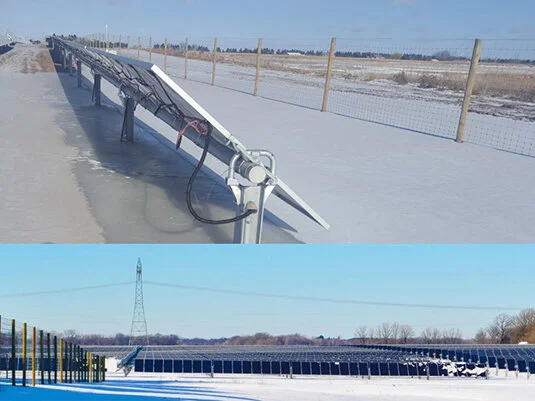
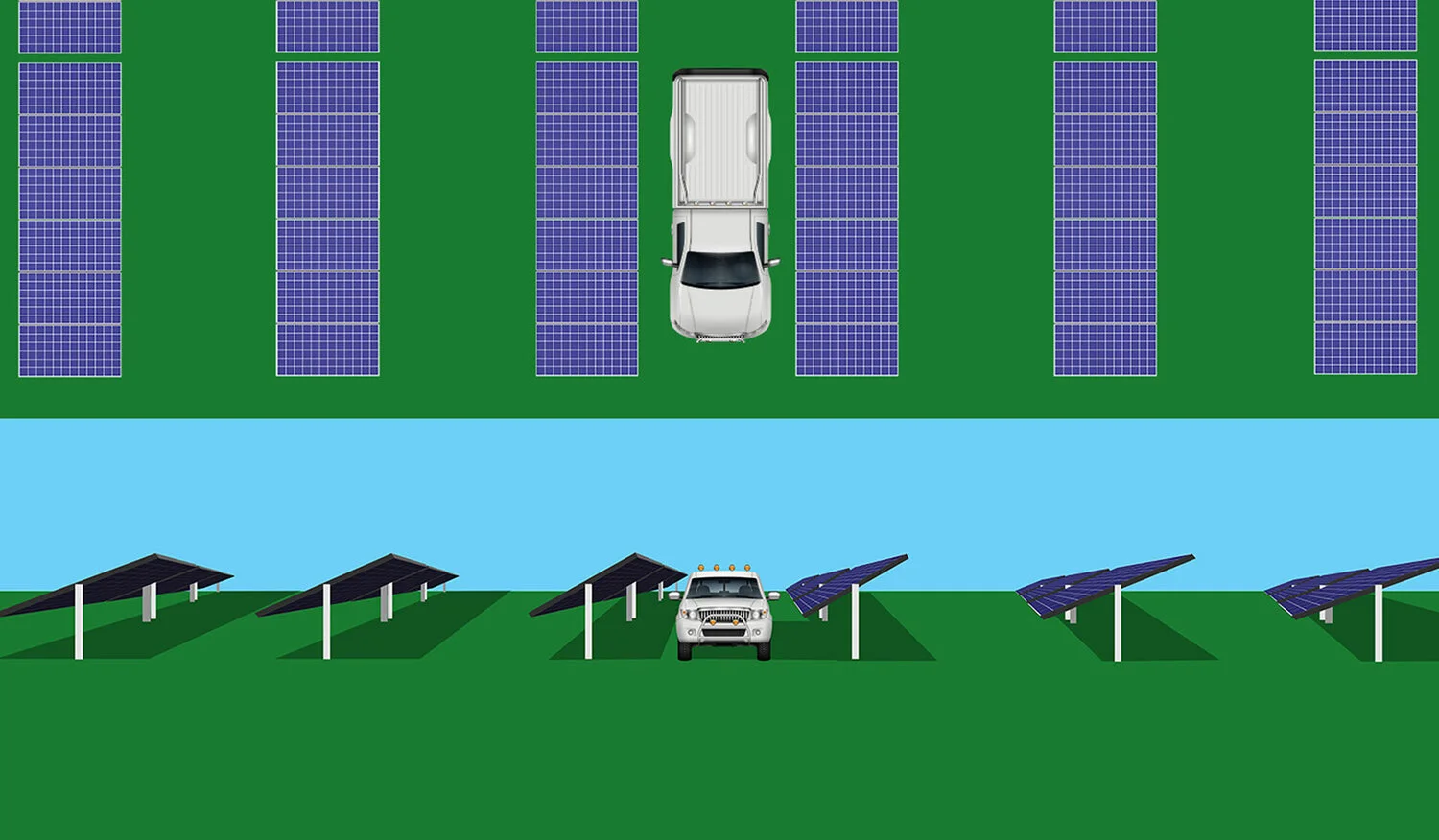
panel rows will be generously spaced
To minimize shadows on adjacent rows and to allow for periodic maintenance, the centers of rows will be spaced about 16-20 feet apart, leaving wide gaps between, even when panels are flat at midday. With this spacing, solar panels and equipment will cover only about 30 percent of the project site.
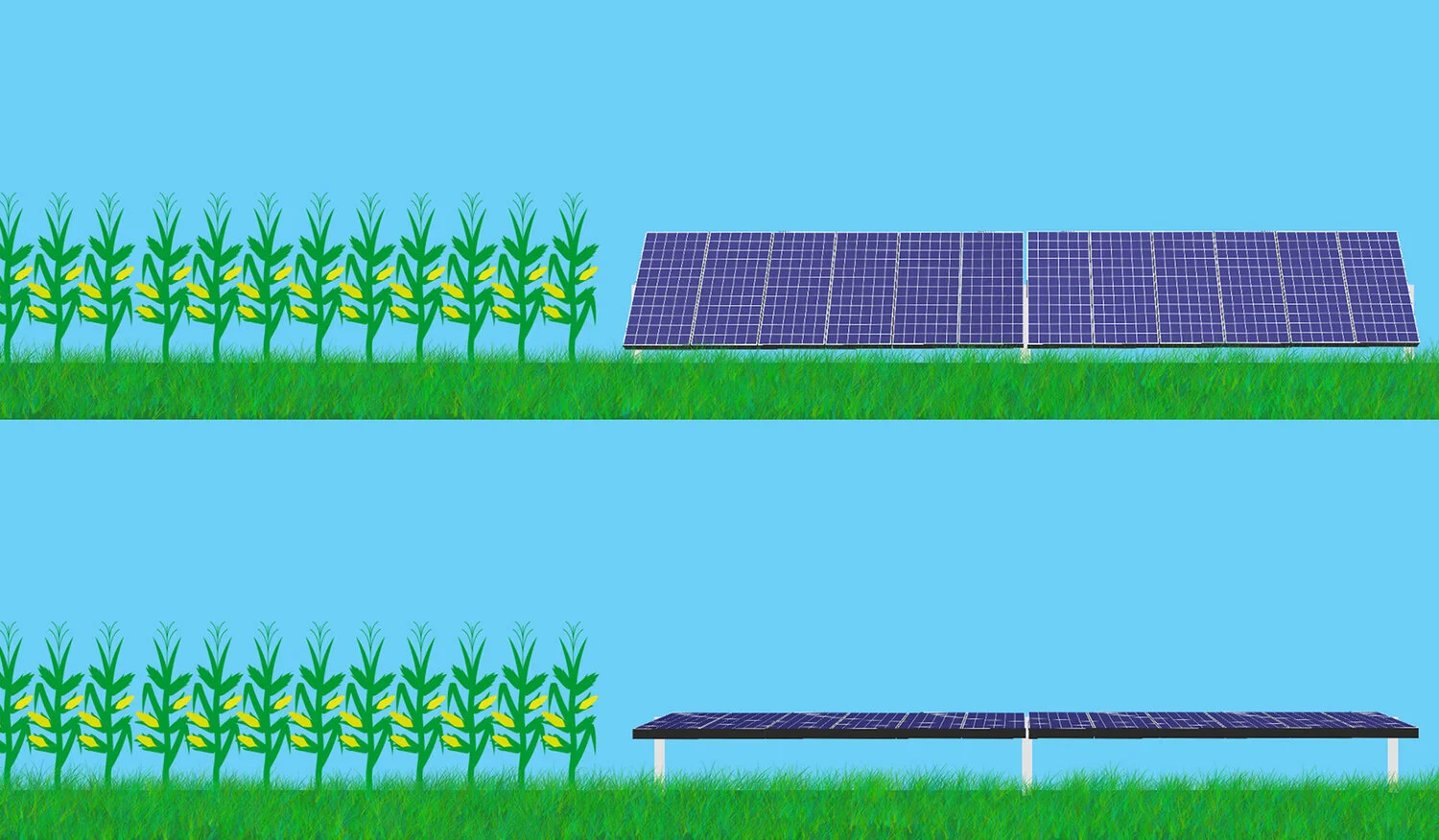
Panels will be about as tall as full-grown corn
Panels will be tallest at sunrise and sunset, when they will be turned toward the sun. Panel rotation will stop at 30 degrees from vertical to prevent panels from facing houses of neighbors. When the sun rises higher than 30 degrees above the horizon in the morning, the panels will start to track the sun across the sky, rotating to flat at midday and then returning to their tallest profile as sunset approaches.
Environmental Benefits
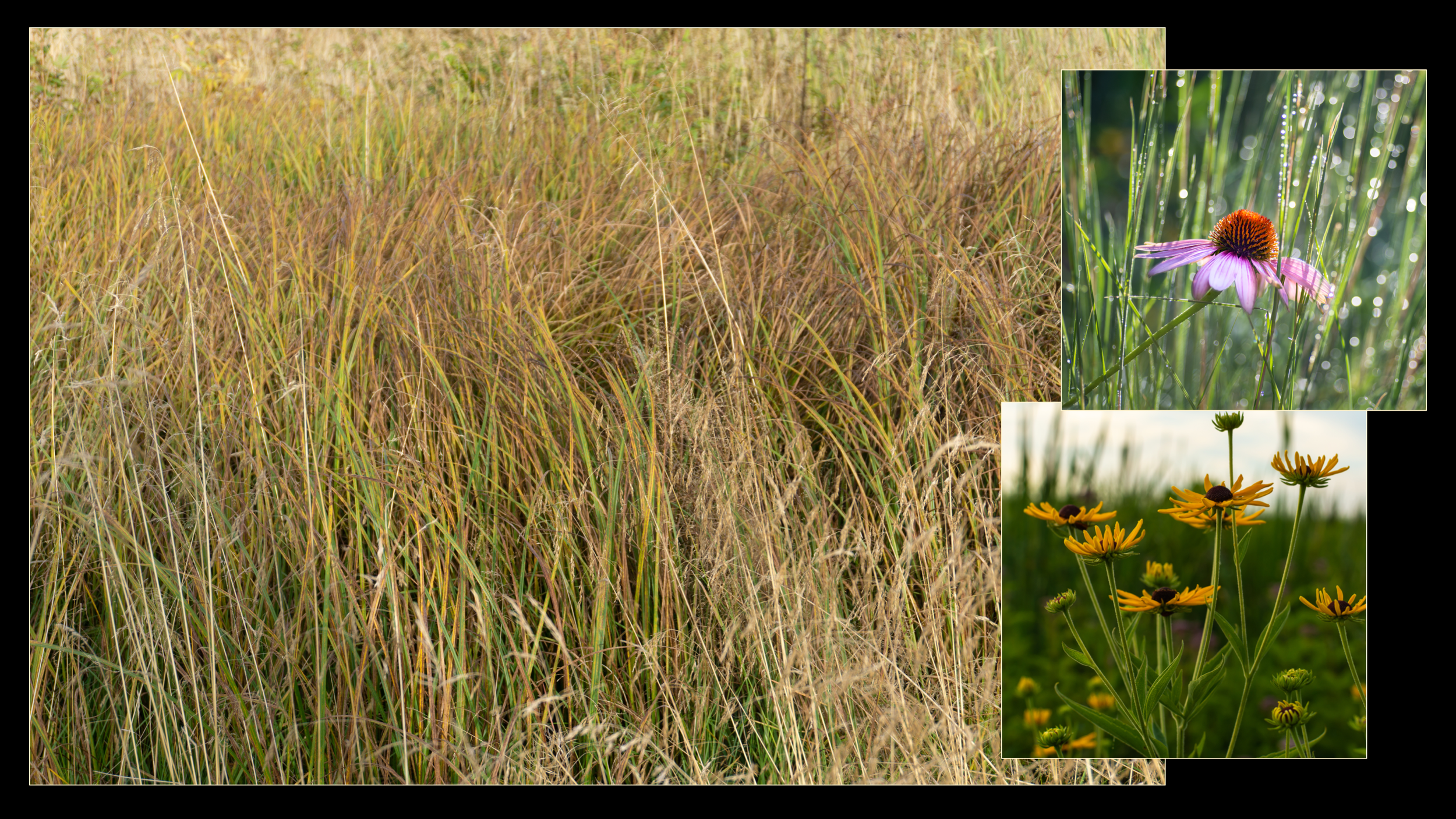
Little Blue Stem prairie grasses are representative of vegetation beneath and between rows of panels. Black-eyed Susan and Coneflower are representative of pollinators that will be included in the vegetation plan around the outside of rows and along fences of the facility.
The site will feature grass and seed mixes below panels and within the site that will help build soil nutrients and reduce fertilizer, herbicide and pesticide use. The facility will create pollinator habitat as well as possible opportunities for grazing.
Reduced stormwater runoff and soil erosion from the land hosting solar panels can improve downstream water quality.
In addition, compared to emissions from Wisconsin’s average generation mix, the project will avoid significant emissions annually*:
Reduction of 160,862 lbs of NOX
Reduction of 117,362 lbs of SO2
Reduction of 40,289 lbs of CH4
Reduction of 5,839 lbs of N2O
Reduction of 407 million lbs of CO2
(*Note: Avoided emissions information comes from the Environmental Protection Agency's "Emissions & Generation Resource Integrated Database.”)
Onion River Solar is designed to generate clean power for Wisconsin for 30 to 35 years.
At the end of project life, facilities will be removed, and the land will be available for agricultural use.

Community & Economic Benefits
Leased land payments will provide income diversification for local farmers while protecting and preserving agricultural land for future generations.
The project will be a significant source of new local tax revenue, with $250,000 expected in annual shared revenue for the Town of Holland and $350,000 expected in annual shared revenue for Sheboygan County. The use of these unrestricted funds can be directed by local officials to best meet the needs of the community.
Jobs created during construction will bring increased economic activity to the community; once operational, the project will directly employ a staff of one to two.
Why Solar?

Our sun’s energy is predictable, unlimited, and free.

Solar power is a clean energy source with no emissions.

Solar systems produce power during the day when demand is high.

Construction of new large-scale solar facilities can create hundreds of jobs.

State governments, businesses, and utilities can use solar to meet their renewable energy policy targets.

Solar projects generate tax revenues for communities which can be used to invest in new roads, bridges, schools or to offset existing tax rates.

The levelized cost of energy from utility-scale solar has declined by 89% since 2009* and has reached cost parity with traditional forms of generation in many regions.

Solar development is temporary and helps to preserve land for
future generations.
*Additional information about the dramatic decline in the cost of solar energy is available from leading financial advisory and asset management firm Lazard at https://www.lazard.com/perspective/lcoe2019.